
What to Expect in Pregnancy After Recurrent Miscarriage
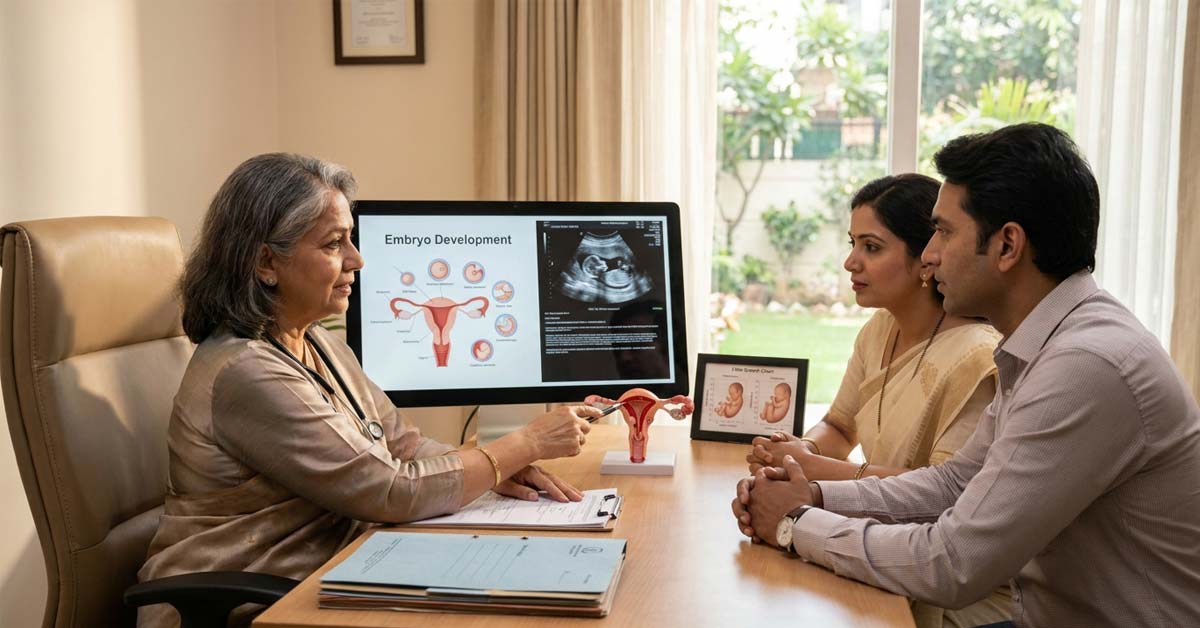
Rashmi, walks back into the clinic for her first scan of a new pregnancy, and her hands are folded tightly in her lap. After two losses, the joy of a positive test arrives wrapped in something heavier — the memory of how the last two pregnancies ended. Every small symptom feels louder this time, every quiet moment more uncertain.
In my practice as an obstetrician, this is one of the most familiar conversations I have. Women carrying the weight of recurrent miscarriage do not need cheerful reassurance. These women with multiple miscarriages often enter the next pregnancy carrying significant emotional and medical anxiety.
 Most clinical content explains why recurrent miscarriage happens, or what bleeding in early pregnancy means. Far fewer answer the question women actually ask once they are pregnant again — what will my next pregnancy be like, and how is it managed differently from before.
This article walks through pregnancy after miscarriage with a clinical lens — the planning before conception, the monitoring that defines a high-risk pregnancy, and the realistic outlook for couples who have experienced repeated losses.
Also Read:
- Bleeding in Early Pregnancy: Symptoms, Causes, and Outcomes
- Recurrent Miscarriage Causes: Why It Happens and What Helps
Understanding Where You Are Clinically
After two or more losses, you are no longer being looked at as an isolated case. Recurrent miscarriage is a recognised clinical category with a defined evaluation pathway, and that framework now shapes how your next pregnancy is approached.
What Recurrent Miscarriage Means for Your Next Pregnancy
Recurrent miscarriage refers to two or more consecutive pregnancy losses, and the medical approach to a subsequent pregnancy is fundamentally different from a routine one. Many couples describe this experience as having two miscarriages in a row before seeking specialist evaluation.
There is also a clinically useful distinction between primary recurrent loss, where there has been no live birth, and secondary recurrent loss, where losses follow an earlier successful pregnancy. This distinction can influence which causes are most likely and what investigations are prioritised before and during the next pregnancy.
Why the Cause Behind Your Losses Shapes What Comes Next
The category of cause behind your previous losses directly shapes how the next pregnancy is monitored and treated. Recurrent pregnancy loss is generally examined across six recognised areas — chromosomal, uterine, immunological, endocrine, lifestyle, and male factor. In a meaningful share of cases, around half, no specific cause is identified despite full evaluation, and this is itself a clinically recognised finding that guides care rather than blocking it.
Understanding your clinical category is the bridge to what comes next. The next pregnancy is approached with closer monitoring, structured planning, and a hands-on medical approach from the earliest weeks.
Planning Before the Next Pregnancy
A healthy pregnancy after recurrent miscarriage does not begin with the positive test. It begins earlier — with controlling underlying medical conditions, completing pending investigations, and ensuring both partners are evaluated where indicated before conception is attempted.
Medical Conditions to Control Before Conceiving
Before planning a next pregnancy, certain underlying conditions need to be brought under clinical control. This is not optional preparation — it is the foundation of how multiple miscarriages are approached medically.
- Thyroid disorders: identified and managed to target levels before conception
- Diabetes: brought under controlled blood sugar levels before pregnancy is attempted
- Antiphospholipid syndrome testing: completed if not done in earlier evaluation
- Lifestyle factors: actively addressed — weight, alcohol, smoking
- Male partner semen analysis: arranged where male factor is suspected
 What Pre-Conception Evaluation Typically Covers
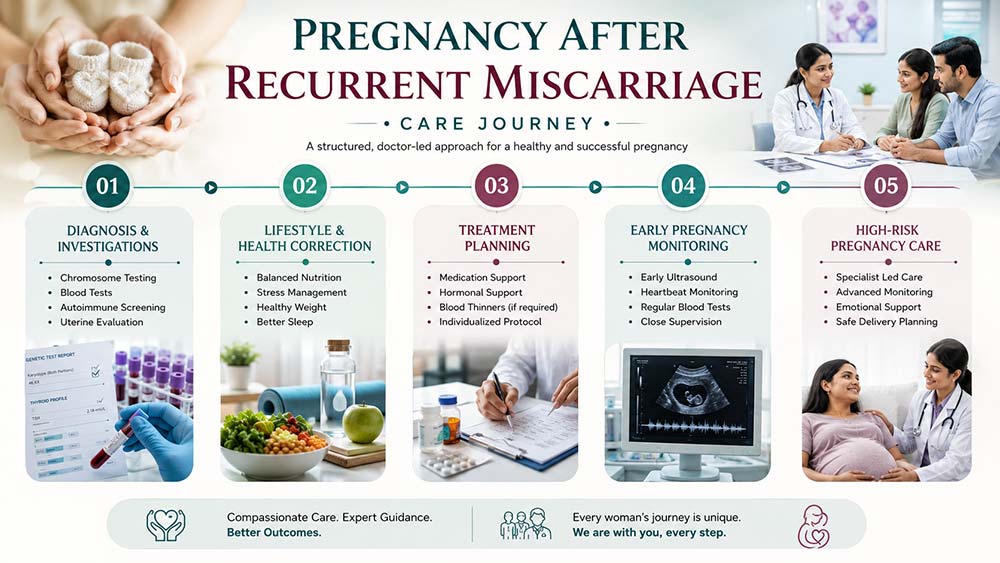
Pre-conception evaluation is not a single test. It is a structured review that pulls together the findings of past pregnancies and current health to build a plan for the next.
- Detailed review: of previous pregnancy history and timing of losses
- Ultrasound assessment: of the uterine cavity, with hysteroscopy where indicated
- Hormonal and thyroid panels: appropriate to the clinical picture
- Antiphospholipid antibody blood tests: where applicable
- Genetic review: where parental translocation is suspected
With underlying factors addressed and both partners clinically optimised, the next pregnancy can begin with a structured monitoring framework already in place from the first positive test.
How Your Next Pregnancy Is Managed Differently
A pregnancy following recurrent miscarriage is classified as a high-risk pregnancy from the first positive test. This classification is protective, not predictive. This is why pregnancy after recurrent miscarriage is monitored through a far more structured clinical framework than a routine pregnancy
What High-Risk Pregnancy Care Actually Involves
High-risk pregnancy care after recurrent miscarriage is defined by more frequent monitoring, additional investigations, and active medical management from the earliest stage. Antenatal visits are scheduled more closely than in a routine pregnancy. Early ultrasound scans confirm viability and track development. Where antiphospholipid syndrome is established, blood-thinning treatment may be initiated and continued under specialist supervision. The overall framework is built around a hands-on approach — more medicines where indicated, more injections where required, and more direct clinical involvement throughout.
When does high-risk monitoring usually start?
High-risk pregnancy monitoring after recurrent miscarriage usually begins from the moment pregnancy is confirmed, often before the first routine scan would be due in a standard pregnancy. Early confirmation through hCG testing, early ultrasound to establish viability, and continuation of any pre-conception medical treatment together form the opening phase of care. The aim is to establish a clear clinical picture early, not to wait for symptoms.
Additional layers of care exist because outcomes are generally favourable when managed properly — not because the pregnancy itself is in trouble. The exact miscarriage treatment options depend on the identified cause and the clinical history of the couple. This high-risk pregnancy monitoring framework begins from the earliest weeks after conception
The Outlook — What Most Couples Can Expect
Most couples who have experienced recurrent pregnancy loss go on to have a healthy pregnancy. The clinical evidence supports this strongly, and the lived experience in clinical practice reinforces it consistently.
- The reassurance that matters most: In clinical practice, most couples after recurrent pregnancy loss go on to have a normal, healthy pregnancy
- Anxiety is expected and addressed: Built into the care plan through closer follow-up, earlier scans, and unhurried consultations
- Specialist care from day one: Couples with two or more losses should be under specialist supervision for the next pregnancy from the earliest possible point
- Outcomes improve with structure: Identified causes are treated directly, unexplained cases are managed under defined clinical protocols
- Hope is clinical, not sentimental: Supported by patient outcomes seen consistently in years of practice
Hope here is not a sentiment — it is a clinical statement supported by outcomes. The right care, started early, gives the next pregnancy the structure it needs to progress safely.
Also Read:
FAQ: Pregnancy After Miscarriage

FAQ1: How to recover from a recurrent miscarriage?
Recovery after recurrent miscarriage involves both physical and emotional dimensions, and both deserve clinical attention. Menstrual cycles typically resume within four to six weeks, and a medical follow-up confirms that recovery is complete and no retained tissue remains. Waiting for one normal cycle before attempting the next pregnancy is generally advised. Emotional recovery is not separate from medical care — it is part of how good care is delivered, and conversations with a doctor or trusted support are an important part of moving forward.
FAQ2: What is the main cause of recurrent miscarriages?
Chromosomal disorders are the most commonly identified cause of recurrent miscarriages, accounting for a significant share of cases. Uterine factors, immunological conditions such as antiphospholipid syndrome, endocrine disorders, lifestyle factors, and male factor contributions are also recognised. In around half of all cases, no specific cause is identified despite full evaluation — this is a clinically recognised category in itself and does not prevent structured care from being delivered.
Conclusion
Pregnancy after recurrent miscarriage is approached with structured medical care from the earliest stage, and the experience is different from a routine pregnancy by design. Pre-conception planning addresses underlying medical and lifestyle factors. High-risk pregnancy monitoring then provides the framework of close follow-up, early investigations, and active management that the history calls for. Most couples go on to have a healthy pregnancy when this structured care is delivered consistently from day one.
Book a consultation today for structured pre-conception assessment and personalised pregnancy planning after recurrent miscarriage.
Our Digital Imprints:
Dr. Madhu Goel
Senior Consultant Obstetrician and Gynaecologist
Director, Fortis La Femme
I am passionate about women’s health and believe that informed, compassionate care empowers women to make confident choices. With experience in high-risk pregnancies, infertility, and gynaecological care, my focus remains on guiding patients with clarity, empathy, and trust.
Stay informed with Health Hub, my newsletter dedicated to women’s health and wellness, where I share evidence-based insights and practical guidance.
You can also connect with me on Instagram | Facebook | LinkedInfor regular updates on women’s health.