

Missed Abortion Explained: Causes, Symptoms, and Recovery
She came in for her twelve-week scan. Excited. Already planning. The missed abortion was the last thing on her mind — the nausea, the fatigue, everything had felt completely normal. The scan showed a sac. No heartbeat.
This is one of the most difficult conversations in clinical practice. Not because the medicine is complicated — but because nothing warned her. No bleeding, no pain, no signal. The body felt pregnant right up to that moment.

Doctor discussing condition with patient calmly
Missed abortion is early pregnancy loss in which a foetal heartbeat was present and then disappeared, with the body continuing to feel pregnant throughout. It is found on ultrasound — often at a routine scan — and that is exactly why it is called missed. Miscarriages occur in approximately 7% to 8.5% of pregnancies in India, with reported increases across both urban and rural populations.
This article explains missed abortion causes, what missed abortion symptoms look like and why they are so often absent, what missed abortion management involves, and how to plan the next pregnancy with clarity and confidence.
Also Read:
- Biochemical Pregnancy: Positive Test Without Pregnancy
- Blighted Ovum Causes Symptoms and Diagnosis Explained
- India’s Falling Fertility Rate: A Doctor’s Perspective on NFHS-6
What Causes a Missed Abortion
Missed abortion causes are almost always rooted in biology, not behaviour. Understanding why it happens is the first step in releasing self-blame and moving forward with clarity.
“A missed abortion is most commonly caused by chromosomal abnormalities during early embryo development, which prevent normal pregnancy progression despite initial growth.”
Chromosomal Abnormalities and Early Development Failure
The most common cause of a missed abortion is a chromosomal abnormality in the fertilised egg. During the earliest stages of cell division, random genetic errors can occur. The egg, the sperm, or the fertilisation process itself may produce genetic material that is not compatible with normal embryo development. When this happens, the pregnancy stops progressing, even if a heartbeat was briefly established.
These errors are entirely random. They are not inherited, not predictable, and not caused by anything that happened before or after conception. They occur at a cellular level that is completely outside the control of the woman carrying the pregnancy. Age is a factor only in the statistical sense: the likelihood of chromosomal errors increases after the mid-thirties as egg quality naturally changes over time, but this is a biological reality, not a personal failing.
Contributing Factors That Increase Risk
Beyond chromosomal causes, certain conditions can increase the risk of a missed abortion. Maternal age above 35 years, excessive body weight, and lifestyle factors such as smoking and alcohol use are among the contributing variables. Hormonal disorders, including thyroid dysfunction and PCOD, can affect the hormonal environment in which early pregnancy develops. Structural uterine abnormalities, such as a uterine septum or an intrauterine polyp, may also interfere with normal implantation and early foetal development.
These are contributing factors, not definitive causes. Many women with one or more of these conditions carry pregnancies to full term without difficulty. Identifying and addressing them before the next pregnancy is part of responsible pre-conception planning.
Missed abortion causes are biological in the vast majority of cases. Identifying contributing factors where possible helps guide pre-pregnancy planning with your gynaecologist and gives the next attempt the strongest possible foundation.
Missed Abortion Symptoms: Why Most Women Do Not Know
Missed abortion symptoms are usually absent, which is why diagnosis typically happens during a routine ultrasound rather than through noticeable physical signs.
What the Body Does and Does Not Signal
This is what makes missed abortion so disorienting. Pregnancy symptoms — nausea, fatigue, breast tenderness, a heightened sense of smell — may gradually fade at some point. A faint brownish discharge may appear. These are the only signals many women notice, and even these are not always present.
The typical signs that women associate with pregnancy loss — active bleeding, cramping, abdominal pain — are usually absent entirely. The uterus does not expel. The body does not alert. Because the placental tissue continues to produce the pregnancy hormone HCG, the body responds as though the pregnancy is ongoing. Everything feels real. This is precisely why the diagnosis almost always arrives as a shock at what was supposed to be a routine ultrasound.
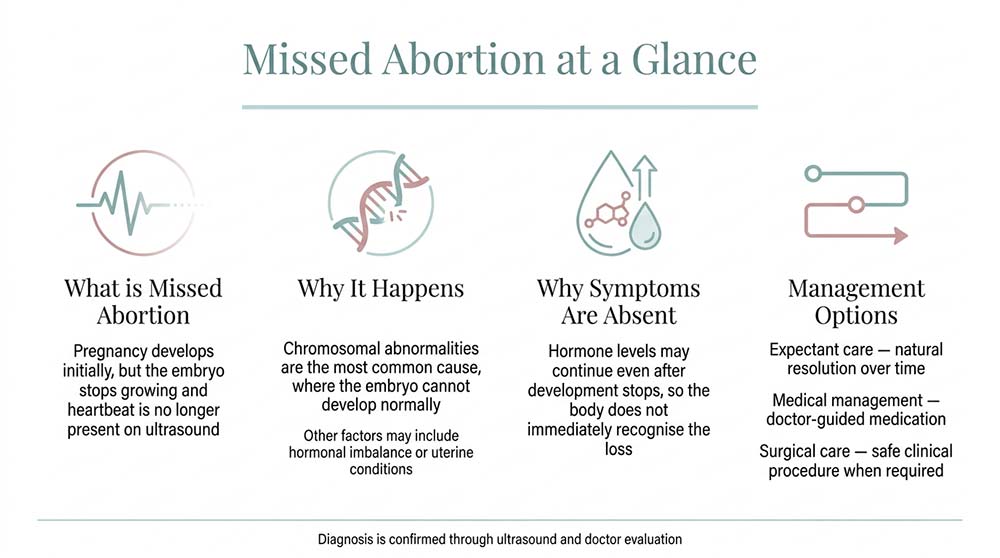
Missed abortion explained in simple visuals
Can You Have a Missed Abortion With No Symptoms At All?
Yes, a missed abortion can occur without any symptoms. The pregnancy may continue hormonally even after development stops, which is why diagnosis is usually made during a routine ultrasound.
If your pregnancy symptoms have quietly disappeared or if you notice only a faint brownish discharge without active bleeding, a clinical evaluation is the appropriate next step — not reassurance from symptoms alone.
Because missed abortion symptoms are minimal or entirely absent, routine early pregnancy ultrasound remains the most important clinical tool for detecting changes before they become emotionally overwhelming.
Missed Abortion Management: Your Three Options
Once diagnosed, missed abortion management is guided by clinical findings, gestational stage, and the woman’s own preference. There is no single correct path. Only the right one for each individual situation.
Expectant, Medical, and Surgical Pathways
When a missed abortion is confirmed, three management pathways are available. The decision is made jointly between the woman and her gynaecologist based on clinical findings, how far the pregnancy had progressed, and the woman’s own circumstances and preferences.
- Expectant management: You wait. In most cases, the body will begin the natural process of pregnancy loss within four to five days. This option requires close monitoring to ensure the process completes safely.
- Medical management: Medication is prescribed to initiate uterine contractions and facilitate the passage of pregnancy tissue. This provides a more predictable timeframe and is managed under medical supervision.
- Surgical management: A minor surgical procedure is performed under anaesthesia to complete the uterine evacuation. This is recommended when there is a clinical indication for faster resolution or when other options have not been effective.
No pathway is superior to another. The right choice depends on your specific clinical situation and what feels manageable for you at the time.
Post-Procedure Care and Recovery
Recovery after a missed abortion involves both physical and emotional dimensions, and both deserve attention.
- Antibiotics: Prescribed after surgical management to prevent infection.
- Rest: Allow your body adequate time to recover in the days immediately following the procedure.
- Diet and exercise: A balanced diet supports physical recovery. Gentle exercise can be introduced gradually as energy returns.
- Emotional support: Feelings of grief, confusion, and sadness are a normal response to pregnancy loss. If you are finding it difficult to cope, speaking with a psychologist is a constructive and appropriate step.
- Timing the next pregnancy: A gap of three to six months before attempting conception again is generally advised. A pre-pregnancy visit with your gynaecologist helps ensure you are physically and hormonally ready.
Missed abortion management is a structured, medically supervised process. Recovery is entirely possible, and most women go on to conceive healthy pregnancies with the right guidance and follow-up care.
When to Investigate Further and Planning Ahead
A single missed abortion does not require extensive investigation. But when losses recur, a clear clinical pathway exists — and it begins with the right questions asked in the right order.
- One missed abortion: Reassurance and recovery. Extensive testing is not indicated after a single loss in most cases. The biological cause is usually a random chromosomal event that is unlikely to recur.
- Recurrent pregnancy loss: When losses follow a pattern — a biochemical pregnancy, then a blighted ovum, then a missed abortion — specific recurrent pregnancy loss testing is clinically advised.
- What testing covers: Chromosomal evaluation of both partners, hormonal assessment, uterine imaging, and thrombophilia screening, depending on individual clinical history.
- The pre-conception visit: A focused consultation to review contributing factors, optimise hormonal and metabolic health, and plan the next pregnancy under structured medical guidance.
- Timing: A gap of three to six months is generally advised before attempting conception again, allowing the body to recover and any identified issues to be addressed.
Planning ahead after a missed abortion is a medical conversation worth having early. It replaces uncertainty with preparation and gives the next pregnancy the strongest possible clinical foundation.

Looking ahead with clarity and strength
Also Read:
- Miscarriage Causes, Symptoms, Recovery, and Future Pregnancy Planning
- Recurrent Miscarriage Causes: Why It Happens and What Helps
Moving Forward After a Missed Abortion
Understanding missed abortion symptoms, missed abortion causes, and missed abortion management helps reduce confusion and supports informed medical decisions.
Missed abortion symptoms are often absent, which is why the diagnosis arrives without warning. Missed abortion management offers three clear, medically supervised pathways — chosen in partnership with your gynaecologist based on your specific clinical situation. With proper follow-up, physical recovery is predictable and future pregnancy outcomes are generally positive.
One missed abortion does not define your reproductive future. Most women go on to conceive healthy pregnancies with the right care and pre-conception planning. You are not responsible for what happened. Stop blaming yourself, and start planning ahead.
If you have questions about your pregnancy loss or next steps, book an appointment for a personalised consultation.