

When Contraception Fails: A Doctor’s Guide to Safe Abortion Care
In my consultation room, one of the most difficult conversations often begins quietly. A woman sits across from me and says she did everything right. She used contraception. She was careful. Yet she is now facing an unintended pregnancy. In that moment, questions around safety, trust, and safe abortion surface, along with confusion, fear, and an unfair sense of self-blame that no woman should carry.
Over the years, I have seen how little the medical reality of contraceptive failure is discussed outside the clinic. Many women are never told that no method works perfectly in real life. When failure occurs, it feels isolating, as though something rare or irresponsible has happened, rather than a known medical outcome.

World Health Organization estimates show that around 73 million abortions occur globally each year. This confirms that unintended pregnancy and abortion are common medical realities, not rare exceptions. Emergency contraception reduces risk but cannot eliminate it entirely. Medicine plans for human biology, not ideal scenarios.
Drawing on my years of clinical experience, this article explains why contraceptive failure is medically expected, how emergency contraception fits into care, and why doctor-guided abortion is a recognised part of reproductive healthcare. The aim is reassurance, clarity, and trust.
Also Read:
- Contraceptive Counseling Access: Empowering Informed Choices
- Common Myths and Misconceptions About Contraception: A Doctor’s Perspective
- Abortion Laws in India: What Every Woman Should Know
Why Contraceptive Failure Is Medically Expected
In medicine, we accept a clear truth. No contraceptive method offers complete protection. This is not a flaw in care or effort. It reflects how biology, timing, and real-life use interact in everyday conditions.
Key medical reasons contraceptive failure occurs
- Perfect use versus typical use: Perfect use follows instructions exactly, while typical use reflects daily life, where delays and errors naturally occur.
- Timing sensitivity: Some methods lose effectiveness if doses are delayed by hours or days.
- Ovulation variability: Ovulation can shift unexpectedly, even in women with regular cycles.
- Hormone absorption differences: Vomiting, diarrhoea, or gut absorption issues can reduce pill effectiveness.
- Drug interactions: Certain antibiotics and medications can interfere with hormonal contraception.
- Metabolism and body weight: Individual metabolism affects how hormones are processed.
- Method-related limits: Condoms can tear or slip, injections can be delayed, and devices can shift.

When these factors are understood together, contraceptive failure is seen as a medical reality, not a personal mistake. This perspective allows doctors to guide women forward calmly, safely, and without judgement.
Emergency Contraception as the First Safety Net
Emergency contraception is designed as an early medical response when regular contraception fails or is not used. Its role is important, but it must be understood accurately.
Emergency contraception reduces the risk of pregnancy. It does not eliminate it. This distinction is critical. Many women believe that taking an emergency pill guarantees prevention. Medically, that is not the case.
When used correctly and early, emergency contraception is effective. When delayed or used after ovulation, its effectiveness drops. It is a safety net, not a substitute for ongoing contraception.
When Emergency Contraception Works Best
Emergency contraception works best when taken as soon as possible after unprotected intercourse or contraceptive failure. Its primary action is to delay or inhibit ovulation.
Different methods have different time windows. Pills work best within defined hours. Copper IUDs, when used, offer the highest protection but require medical insertion. Timing is central to success.
Early action increases effectiveness. Delay reduces it. This is not a moral judgement. It is pharmacology and physiology.
Why Emergency Contraception Can Still Fail
Emergency contraception may fail if ovulation has already occurred. Once fertilisation has taken place, these methods cannot reverse it. Weight, metabolism, and hormonal variations also influence outcomes.
Repeated use within a cycle can disrupt timing but does not guarantee prevention. Incorrect expectations often lead to shock and distress when pregnancy still occurs.
From a medical perspective, this is why emergency contraception is framed as risk reduction, not certainty. Understanding this prepares women for next steps without panic.
When Unintended Pregnancy Occurs Despite Precautions
An unintended pregnancy can occur even when contraception is used correctly and on time. When this happens, medicine shifts focus immediately from prevention to care. This transition is essential to protect health, reduce fear, and support clear decision-making.
What happens next in clinical care
- Unintended pregnancy defined: A pregnancy that was not planned at that time, despite preventive measures.
- Medical confirmation: Pregnancy testing followed by accurate assessment of gestational age.
- Health evaluation: Review of medical history, symptoms, and any risk factors.
- No urgency or blame: Decisions are not rushed and fault is not assigned.
- Counselling and discussion: Options are explained based on health status and timing.
- Emotional reassurance: Support is provided to reduce anxiety and isolation.
Handled correctly, this stage should feel calm and structured. Medicine approaches unintended pregnancy with protocols and respect, ensuring women feel supported, informed, and safe as care moves forward. After abortion care, doctors also guide women in choosing the most suitable birth control methods for family planning.
Why Safe Abortion Exists Within Standard Reproductive Healthcare
Safe abortion exists because medicine acknowledges reality. Contraception reduces risk but does not eliminate it. Continuing pregnancy is not always medically, socially, or personally appropriate for every woman.
Within reproductive healthcare, abortion is not an exception. It is part of a continuum that includes contraception, emergency care, pregnancy management, and future planning.
When provided under medical guidance, safe abortion protects health, fertility, and wellbeing. It replaces unsafe practices with science backed abortion care.
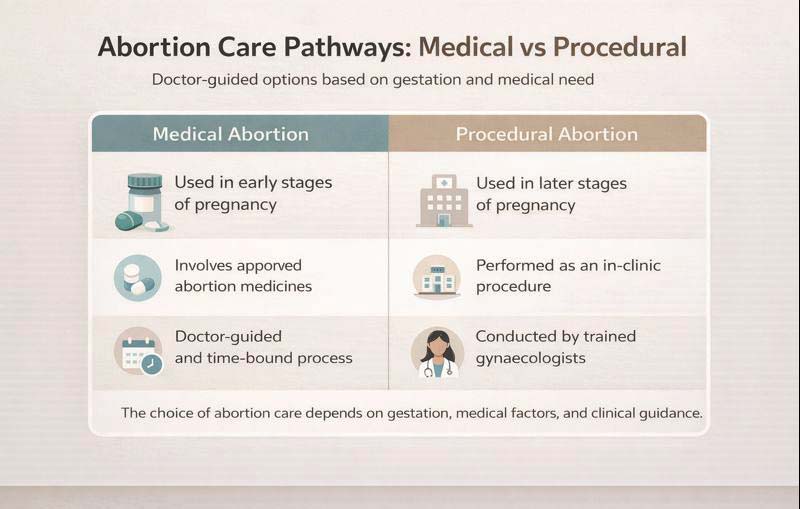
Abortion as a Continuum of Reproductive Care
Reproductive healthcare is not a single decision. It is a journey. Contraception aims to prevent pregnancy. Emergency contraception manages early risk. Abortion addresses situations where prevention does not succeed.
These are not contradictory steps. They are connected. Each exists to support women at different stages of reproductive life.
Viewing abortion in isolation creates fear. Viewing it as part of healthcare restores perspective.
Doctor-Guided Care, Responsibility, and Ongoing Support
When a woman consults a doctor after contraceptive failure, the role of the clinician is clear. It is not to judge what happened before. It is to assess health, explain options, and guide safe decision making based on medical standards. This shift is crucial because medicine treats failure as data, not as a moral judgement.
Contraceptive failure is clinically a probability, not a lapse. Biology varies. Timing shifts. Outcomes differ even with correct use. Once pregnancy occurs, responsibility moves away from past actions and toward present care. This is where doctor-guided support makes the difference between safety and risk.
How doctors ensure safety and trust after failure
- Health assessment comes first: Gestational age, medical history, and current symptoms are evaluated carefully.
- Failure is treated as medical data: It is expected, documented, and planned for within healthcare systems.
- Options are explained calmly: Decisions are guided by health status and timing, not urgency.
- Informed consent is central: Care proceeds only with clarity and understanding.
- No secrecy or blame: Transparency and reassurance are part of medical safety.
- Confidentiality is protected: Trust allows women to seek care without fear.
- Support continues beyond the procedure: Recovery and future planning are part of care.
Safe abortion is a doctor-guided medical process that exists to protect women when contraception and emergency measures do not prevent pregnancy. It is part of standard reproductive healthcare, grounded in assessment, consent, and clinical safety, not pressure or silence.
 Instead of self-blame, women should feel safer and more support from healthcare. This approach restores trust, protects health, and helps women move forward with clarity and confidence.
Also Read:
- Contraceptive Counseling: Choosing the Right Method for You
- Life After Abortion: Recovery, Counselling, and Contraception Planning
Conclusion
After years of clinical practice, I have learned that clarity reduces fear more effectively than reassurance alone. When women understand why contraception can fail and how medicine responds, panic gives way to confidence.
Safe abortion options is there because healthcare is for real lives, not ideal scenarios. It is a structured, doctor-guided response when prevention does not work.
If you are facing this situation, know that you are not alone and not at fault. Consult a qualified gynaecologist, ask questions openly, and allow medical guidance to support you through informed, compassionate care.
Our Digital Imprints:
Dr. Madhu Goel
Senior Consultant Obstetrician and Gynaecologist
Director, Fortis La Femme
I am passionate about women’s health and believe that informed, compassionate care empowers women to make confident choices. With experience in high-risk pregnancies, infertility, and gynaecological care, my focus remains on guiding patients with clarity, empathy, and trust.
Stay informed with Health Hub, my newsletter dedicated to women’s health and wellness, where I share evidence-based insights and practical guidance.
You can also connect with me on Instagram | Facebook | LinkedInfor regular updates on women’s health.